Cold War Steve Meets The Outside World (2020).
Whilst in the Ramada M1 North on Friday night I spent a bit of time watching the a video and then writing up the review and remarks based on it.
Lockdown
In 2020, during possibly the most extreme part of the Covid 19 Pandemic, including lockdowns and restrictions, the artist known as Cold War Steve embarked on a tour of Britain visiting Bournemouth, Medway, Barnard Castle, Liverpool and Coventry.
He was working with his manager and team to install pieces of artwork in locations at these places and often using unusual techniques to display the work.
Cold War Steve, an artist whose real name is Chris Spencer who began producing digital collages of Steve McFadden (Phil Mitchell from Eastenders) photoshopped into images from the cold war. He was using basic photoshop techniques to cut and paste photographs of the Eastenders hard man amongst photographs of missiles and politicians from the troubled period of the 1970s and 1980s. He began this work in March 2016 and over time his frustrations with politicians and people in general began influencing his work. Brexit was talked about throughout the late 2010s and he was already lampooning famous politicians when the Coronavirus pandemic took hold which led to a ramping up in his popularity as an artist.
In 2020 he was filmed for a documentary film of his journey to these places to install and unveil his art, he discussed the reasons behind his art such as mental illness, suicidal ideation and even a “drink problem” which sounded more serious than was let on. He suffered from panic attacks and feeling unable to go outside before allowing his work to help him. He states that he now considers himself as an artist but for a while did not understand why people would be interested in exhibiting his work or even making a documentary about him and his work. Imposter syndrome appears to have played a large part in his modesty, but in this documentary you can really see his apprehensiveness and nervousness showing on his face and in his body language.
Presentation Skills
The collages that he had made for this tour were to be printed in a large format, and displayed in various different ways, at different locations. As part of our work at university this year we will need to look at how we present our work to the world and this documentary serves me well by informing me of the varied methods of presenting artwork to the general public.
Medway Mirth
The first piece of the journey featured eleven artworks that would be displayed on an arts trail in Medway in Kent, with one piece in the water on a frame, another two next to a walkway, and others right on the waterfront. This last piece was an emotional collage of a beach in the south of England illustrating the death of a woman and child on the sand, overlooked by Priti Patel who was Home Secretary at the time. In the picture the woman and baby are extracted from an old painting and laid on the contemporary beach, whilst the woman with Priti Patel’s head transplanted onto is also from an old artwork. The most haunting part of the image for me, and probably everyone who has seen it is the beaming smile, almost a laugh on Patel’s face as she gazes upon the stricken pair’s bodies.
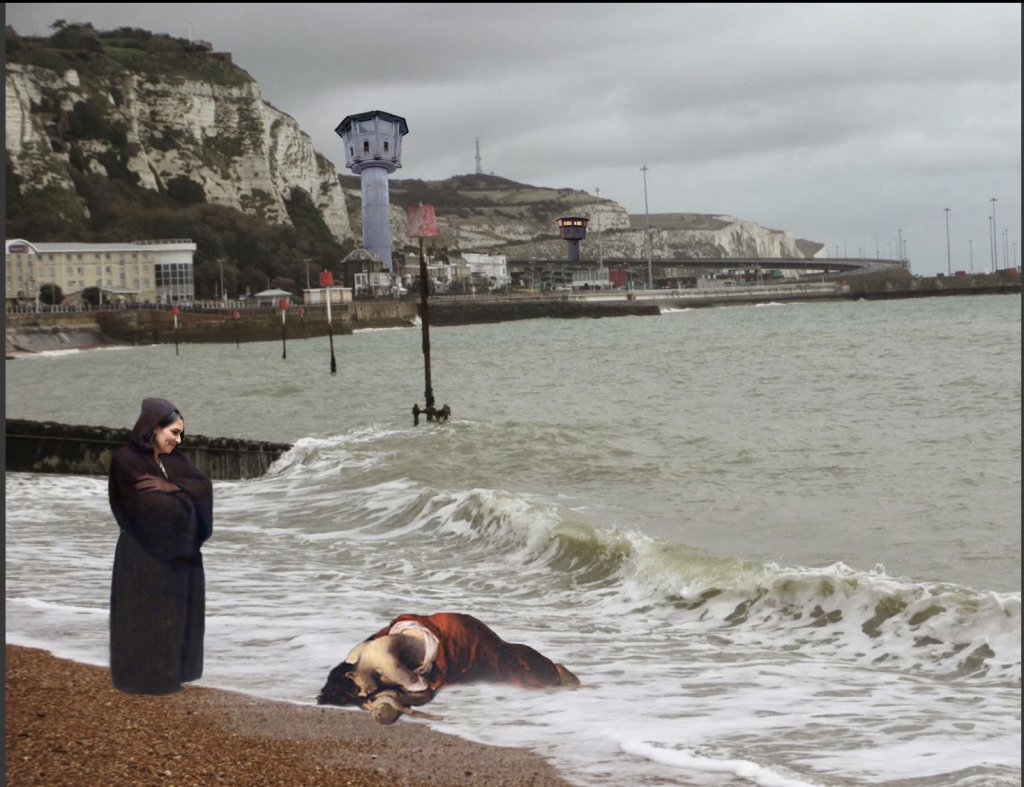
Mounting this piece on the waterfront was starkly appropriate and told an important message about the feelings in the UK government at the time, or at least the perceptions of the Government. Mounted on a frame where it can be looked at closely and even damaged easily if someone chose to, was a brave move and allowed for a close relationship and detailed examination, where these artworks would usually be seen on a mobile device’s screen where you need to zoom in and pinch to see the detail of the image.
Filming shows that there was a mixed reception to the artwork with locals complaining on social media platforms that any art on display should be beautiful like a landscape, not this childish rubbish. This was the least of the issues that the team would have on their travels.
Beside The Seaside
In Bournemouth, the plan was to erect a curved canvas windbreaker, similar to those holidaying families might erect around their deckchairs and picnic blankets, but huge in scale. It was to be double sided with one side showing the best of Bournemouth and the positive stories that come from the people of the coastal town. The opposite side was the “dark” side and showed a nightmarish hellscape with Nigel Farage and Rupert Murdoch appearing as huge worms poking out of the beach. Politicians from all parties, UK and worldwide, live and dead, all appear in this document of the day.

The Bournemouth Council were happy to host this huge installation on the Boscombe Beach but changed their minds once they’d seen the contents of the final art piece. The light side was ok to be displayed, whilst the dark side was deemed to be too provocative and raise ill feelings about the Covid pandemic handling of the council amongst other reasons that meant they were more comfortable covering the side over with black tarpaulins than leaving it on display. Censorship was mentioned by the press, the visitors who saw it being erected and the artists too.

In The Dock
Controversy followed the team to Liverpool where they were originally planned to install a floating jigsaw titled “Trumpscape” on the Albert Dock, but had to move it to an open square in front of the Liver Building. Again the council had stated that it promoted a sentiment that they felt uncomfortable with in that area of the city. Censorship was mentioned here too, but the location was still a good place to display this work and there was some engagement from passers by whom otherwise may have not been able to see the detail in the artwork.

Eye Test Castle
One of the large pieces was of some of the government at the time at Barnard Castle, the scene of a particularly controversial news revelation featuring Dominic Cummings, basically having a laugh at the expense of the British public who were doing their best in the grand scheme to adhere to the rules laid out by the government to prevent covid deaths. This was referencing his visit to an area he should not have travelled to, to “test his eyesight”, this became the one point many people remember about Cummings throughout the whole Covid pandemic.
Canal Card
The last part of the documentary showed Cold War Steve and his fabrication team mount a large postcard on a canal barge and then launch it at Spaghetti Junction (Gravelly Hill Junction) in Birmingham and float it all the way to Coventry Canal Basin where it would be displayed for a period for the local people and visitors to see. This being Covid and a difficult time for the residents of the UK there wasn’t allowed to be a large build up and reception. If they had marketed it and built up a large planned attendance, the Coventry Council would have prevented them from displaying the work as it was. The work on the postcard “Five Blind Mice” showed a number of prominent politicians going to a Quarantine Rave Party, featuring controversial figures in the public eye at the time.
The works on large canvas stretched across the sand, a floor mounted jigsaw, on a narrowboat mounted postcard, sunk into river waters and on the waterfront of a large river are all non-standard locations and methods for displaying artworks. Some were controversial but some were widely accepted by the general public, all started conversations. Discussions about who appeared in the large scale collages and the reasons they appeared there began important dialogues about the contemporary politics and reflecting upon historical politics.
Reflection
It is important to understand the context of the work, the location proposed and the mounting method too. This ensures that the work gels with the environment and negates some of the criticism that could be levelled at it. It also becomes more accessible to the general public, which removes the social gap that we would normally associate with public artworks. Usually they are fenced off or accompanied by large DO NOT TOUCH signs, but these works were left in the environment for everyone to stand up close to and examine.
The struggle to do this work in a large format and in the various guises was made inordinately more challenging due to the conditions at the time and the restrictions in place on socialising and social distancing. The film is interspersed with news broadcast footage and audio from the day that makes this documentary a valuable time capsule of the country in pandemic times.
The work that Cold War Steve continues to produce to this day is often scathing and critical of societies elite classes whilst still mixed in with some obscure British figures from sport and culture that ground the images and remind the viewer that this is just an artist poking fun at the ruling classes.
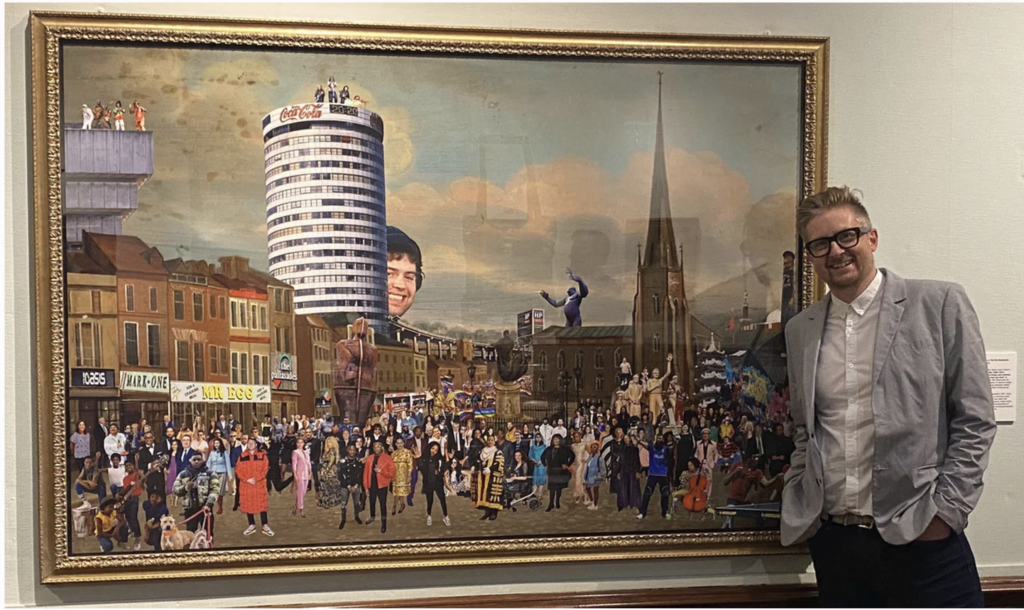
Most of the work is published to Instagram or X (formerly Twitter) and is also represented in galleries in a large format. One particular piece called Benny’s Babbies, featuring Benny from Crossroads over a Birmingham Bullring featuring many important characters from the West Midlands area, has been at the Birmingham Museum and Art Gallery mounted alongside other hugely famous works.
The film was published by Sky Arts and can be found online and on various different streaming services.
Be First to Comment