Well what a few weeks that has been getting my draft dissertation ready to submit to the canvas portal.
My dissertation is focussed on the use of photography to assist in the grieving process and also to discern if this can affect people experiencing the loss of a building. Mainly the dissertation was proposed to discuss grief in the structure as originally explained in October.
- Introduction
- Question and overall expected outcome
- Main Body
- Section 1
- What is grief?
- Why do we grieve
- How do we grieve?
- What strategies are common?
- Can we grieve for non-human loss?
- Section 2
- Photography concerning grief
- Examples of photography illustrating loss
- Photography and memorialising.
- Other art forms used in processes
- Section 1
- Conclusion
- Does photography help or hinder?
- Does this concur with other information?
- Opportunity for further study?
- List of References
- Bibliography
- List of Illustrations
This didn’t turn out to be the exact structure but it was a good starting point for the remainder of the work to pull it together.
The dissertation was to be 5000 words +/- 10% and due to be submitted to the portal on the by 2pm on Tuesday 9th December.
Over the last two months I’ve been gathering together reasearch using a few different sources.
- Wolverhampton Uni Library Search
- Google Scholar
- Wolverhampton Library
- Shrewsbury Library
- Personal Book Collection
With all of my research links I’ve been saving them to MS Onenote in a research page dedicated to links and brief notes about the topics I found interesting in them.
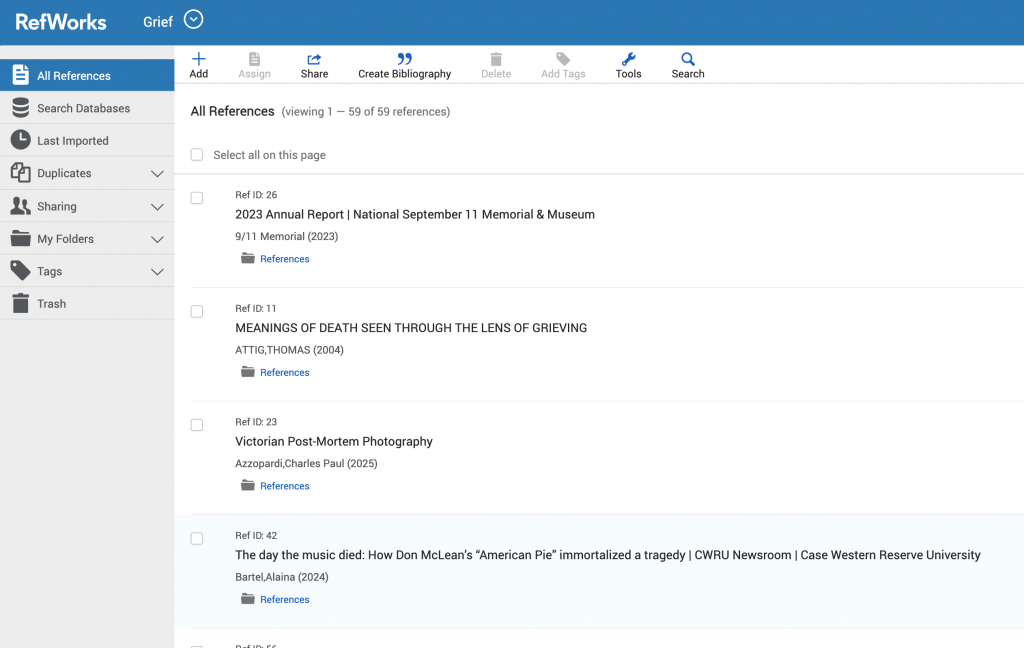
Upon finding some items in the Wolverhampton Online Library Search I was able to save them to RefWorks, which assists in collecting references together for different projects where they can be easily exported.
Another tool I use for recording references is mybib.com website, which I was told about two years ago and have used it since. It seems to be more flexible than RefWorks and easier to import and export from. The setting in Mybib can be set to all different sorts of Citation Styles and the correct one for this dissertation is University Of Wolverhampton’s Harvard Referencing.
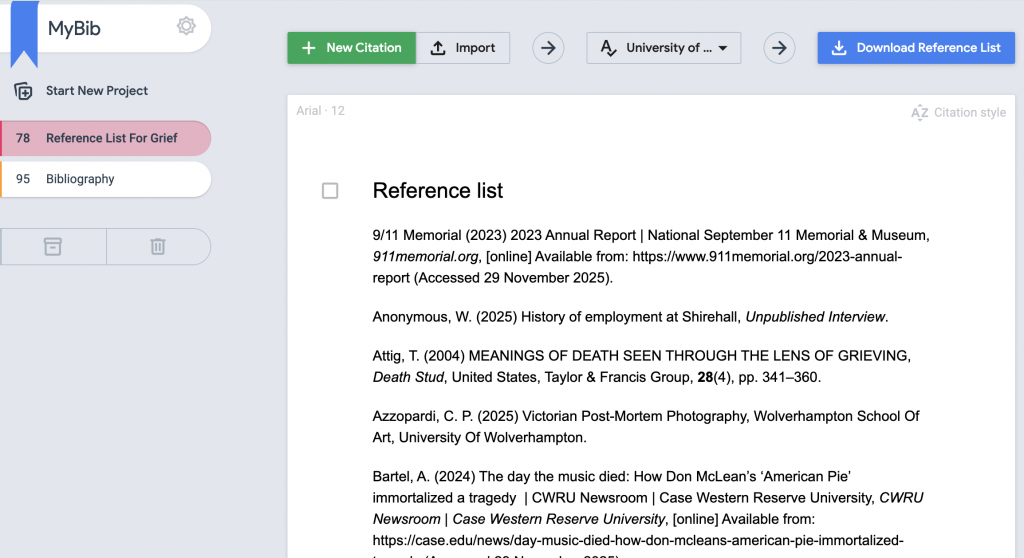
As you can see from the screenshot above the references cited in the dissertation are 78. The Bibliography contains 95 as it contains many sources or articles that I did not cite, but I have read to inform the project. The two appendices of the project are Reference List and Bibliography, it took me some searching to figure out that the Bibliography needed to contain all cited and uncited works, as I was close to just including the uncited work to keep the page quantity down. Looking into the internet to discern what a suitable number of references should be for a 5000 word essay, the average looks like 50-60, so I’m only just over the top by a small amount.
There were a few different types of sources cited or listing in the bibliography:
- Journal Article
- Book
- Movie
- Youtube Video
- Podcast
- Song
- Painting
- Website
- Interviews
- Photographs
Each of the references needs to be structured in a suitable manner to align with Harvard Referencing and for this I used citethemrightonline.com which can assist in formatting them correctly.
Mybib is a good tool for this too as it knows what the format should be, asks for missing data to be populated and then produces an aligned citation or bibiography entry.
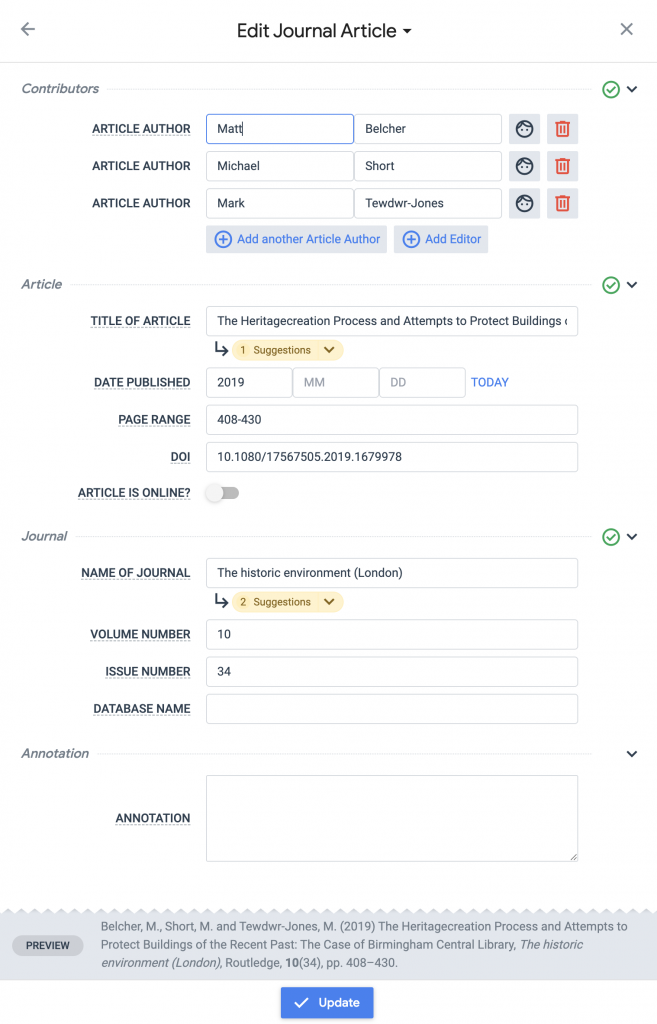
As you can see from the grey section at the bottom it gives you a preview of what the entry will look like and once it is in the list will allow you to copy the in text citation and the bibliography entry, as can be seen below.
In text citation: (Belcher, Short and Tewdwr-Jones, 2019)
Bibliography entry: Belcher, M., Short, M. and Tewdwr-Jones, M. (2019) The Heritage creation Process and Attempts to Protect Buildings of the Recent Past: The Case of Birmingham Central Library, The historic environment (London), Routledge, 10(34), pp. 408–430.
At the end of the writing and revising I can download the reference lists and then copy and paste them into the word document.
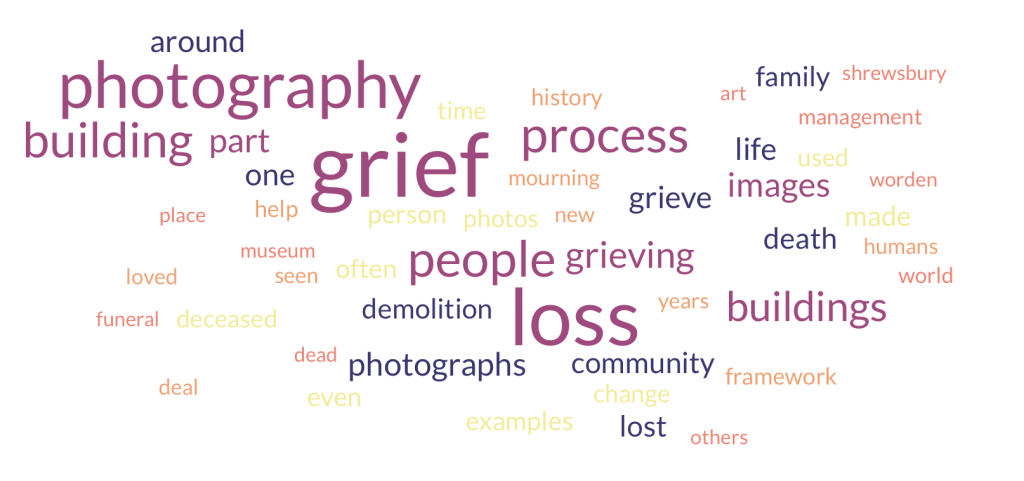
Another thing that the specification of the dissertation mentions is Keywords and after reading up about selecting the best keywords I chose to copy and paste my text into a word-cloud generator to pick up the top words that were used throughout the essay.
Version Control
To complete this work I normally start with a version 1 and then as I get to the end and then go back and revise it, I save a copy as the next version, then work on this document. The idea being that if I damage the document irreparably I can revert back, I know OneDrive does Previous Versions but I like to have a file for certainty. After the last 8-10 weeks I have finished on version 10 after including the changes spotted at reviews.
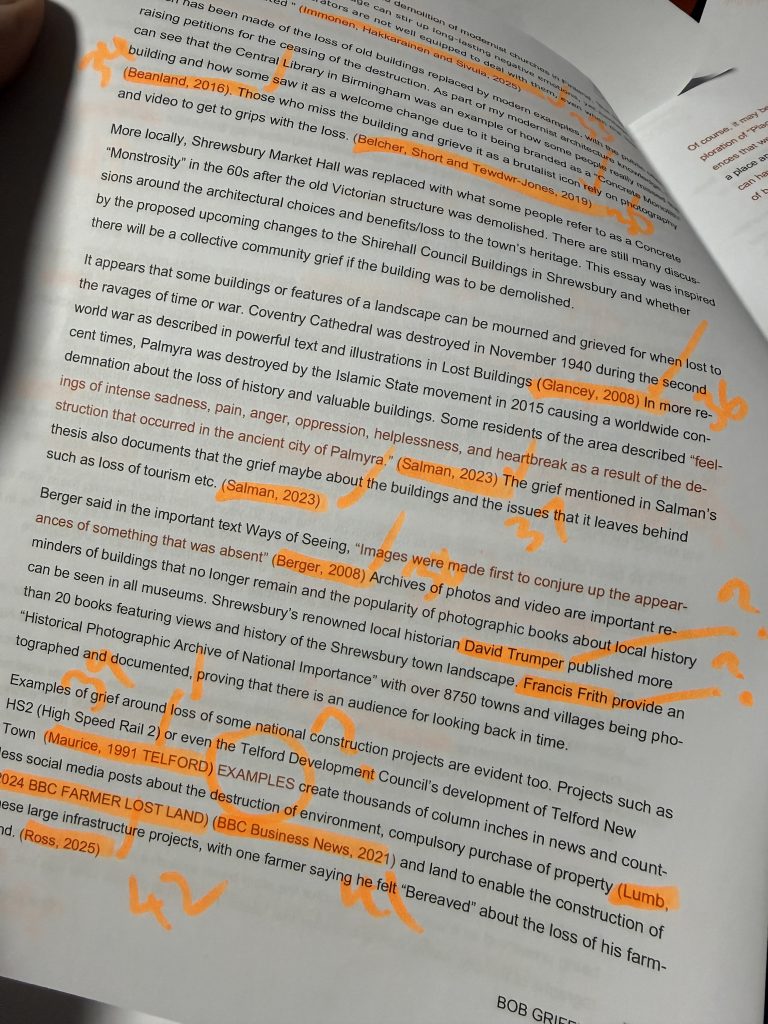
For the changes from v9 to v10 I printed out the whole essay and then sat with a highlighter in my kitchen, away from any distractions then read it on paper, thoroughly and made scribbles with the highlighter to show anything that needs altering. You can see from the above version that I had quotes and references in red text so that I could easily find them for checking them to ensure that I have a corresponding entry in the Reference List. These would be changed to black text for the final submission.
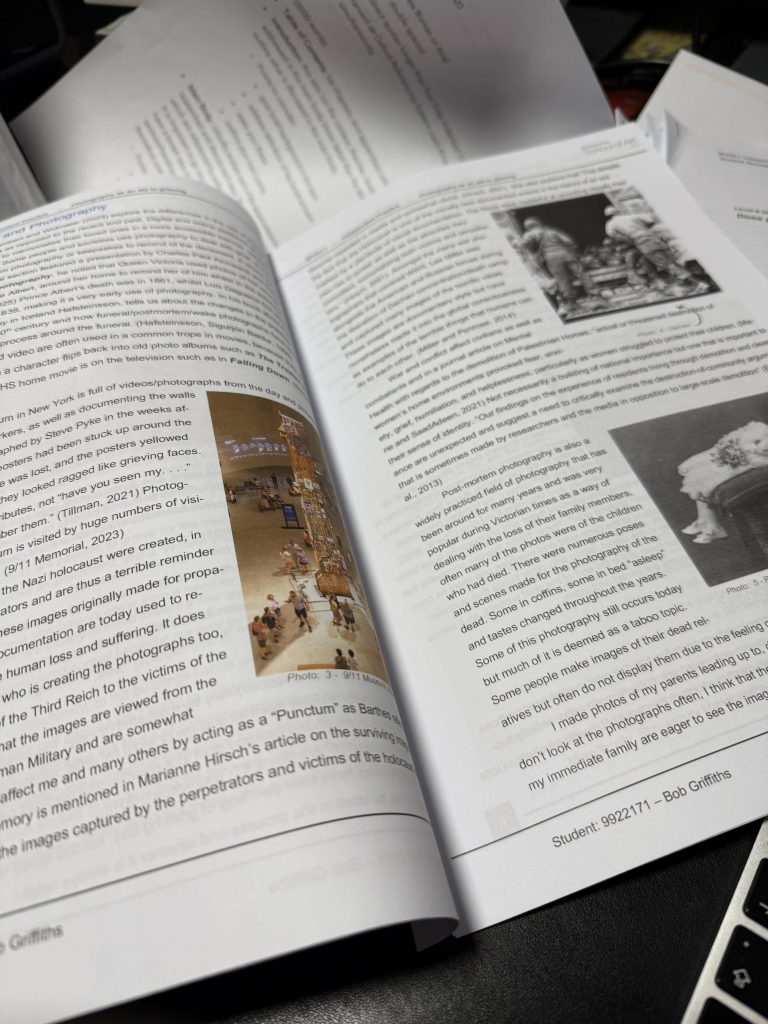
As you can see from the above photo I have now added photographs, headers and footers and also changed the paragraphs so that there is less white space between paragraphs. Looking at other papers and articles that I have been seeing in the research process I can see that there is less attention paid to making white space a priority, and more of a priority to get the column inches in as quickly as possible.
I Submit
Once I was happy with the format of the whole document and the way the paragraphs are worded, it was time to update the Bibliography and Reference List and then get it submitted to the portal.
I needed to check the word count first though and the limit was between 4500 and 5500 so after selecting everything from the beginning of the Introduction to the end of the Conclusion MS Word showed a value of 5473 words. Just squeaking in by a hair’s breadth.
Then it was time to upload but I wanted to upload a PDF rather than a Word Document so I converted it and then uploaded it. Now I have to wait for the Christmas break so that our tutor can read through the drafts and provide some feedforward ahead of the hand in next year of the full document.
I would expect to hear that my writings don’t contain enough arguments against using photography for the grieving, there are a couple of sentences but not enough about studies.
It may even be mentioned that I have too much about grief of human loss and not enough about the loss of buildings but there is not as much information out there for this subject. There are plenty of examples of upset people in the news but very few scholarly articles about loss of buildings, that I was able to dig out anyway.
On the whole I’ve probably spent upwards of 40 hours to get this written, not including the research hours which would probably triple the figure. I know that it is a Draft hand in and not the finished article, but I know after the christmas break the workload will grow and I don’t want to have to completely write this 5000 words from the beginning. Many of my coursemates have spent much less time on this draft, as it is purely a draft, but I think that the benefits of having my tutor read through it and provide improvement advice is a massive positive.
What Now?
At least now I can think about getting back out with the camera and taking some photographs!!
Talking of which, tomorrow is the day we are curating and hanging the exhibition in the foyer for the Level 6 Interim exhibition and I’m quite excited to see how my picture looks now it has been framed and mounted. That will be in another post though. Cheers.
Be First to Comment