Tuesday 13th October
This week we will be presented with a seminar on Curation of Exhibitions by Euripides, my course tutor and course leader.
With a home match for Wolverhampton Wanderers it was a real struggle to park the car today as all my usual spots were rammed.
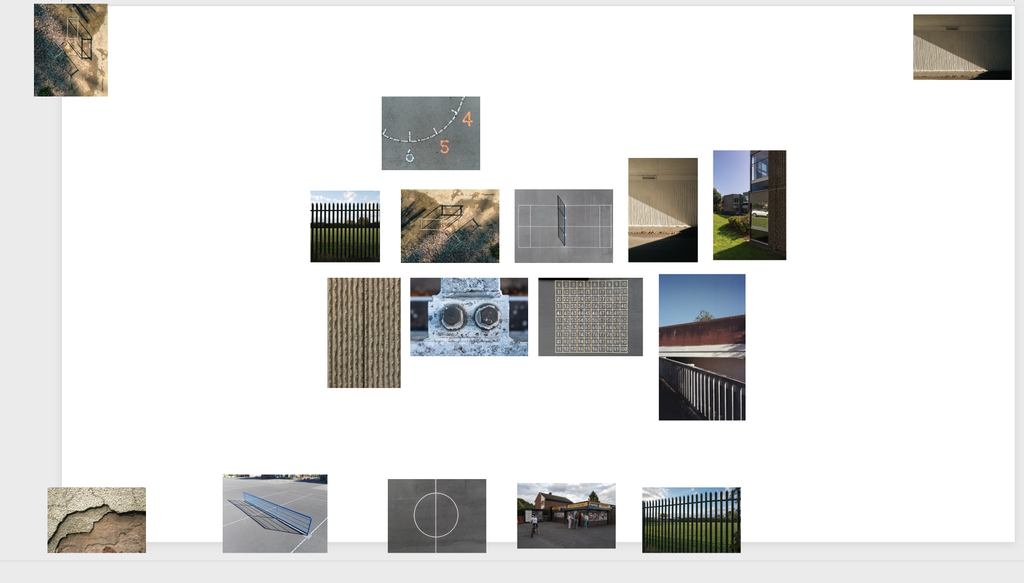
In to the studio to begin writing up my notes and also rearrange some of the works at the review yesterday into a single slide as an example of a gallery sequence. Sam had a documentary playing off his laptop onto the large screen and I spotted Peter Mitchell whose talk I went to in Leeds earlier this year at Photo North Fest.. He was watching Britain In Focus that was on YouTube. I will check this out at some point int he near future.
Bookworm
I went to the Harrison library and sat down with an issue of British Journal of Photography and a copy of Aperture. I noted that in Aperture 246 there was some work on camera obscuras and multi image photos like a bird in flight so I messaged Marie about it in case it helps her with her residency.
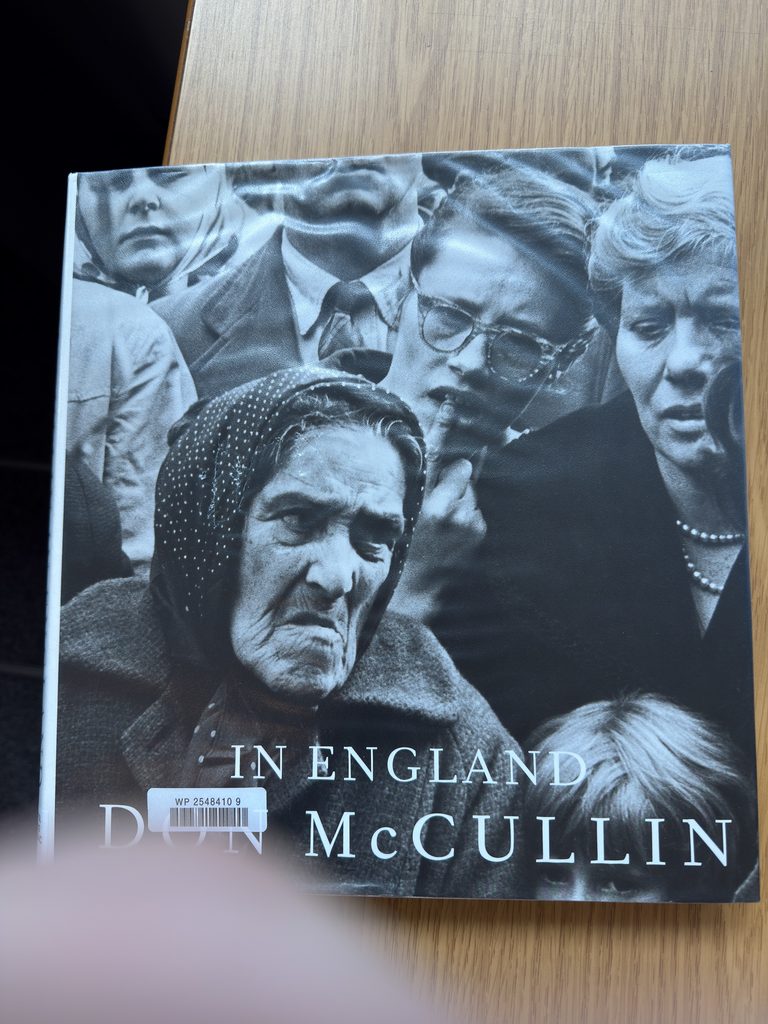
Picked up a book up on the third floor (779.092 Mac) Don McCullin In England. I knew that he was quite famous for his war photography but this book helped me understand some of his background too.
He was born in London during the war and was evacuated, upon returning home he began to document the people, the immigrants and the place. I’ve also noticed that in this book McCullin photographs people down on their luck too, drunks and homeless as well as regular people and posh peeps too.
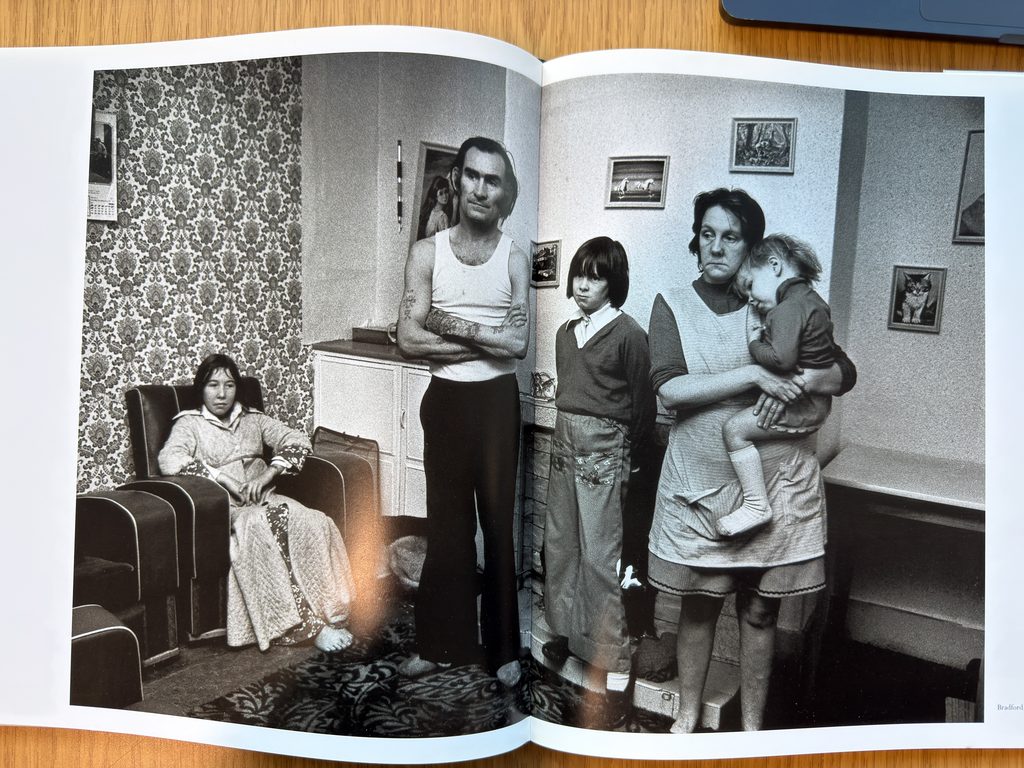
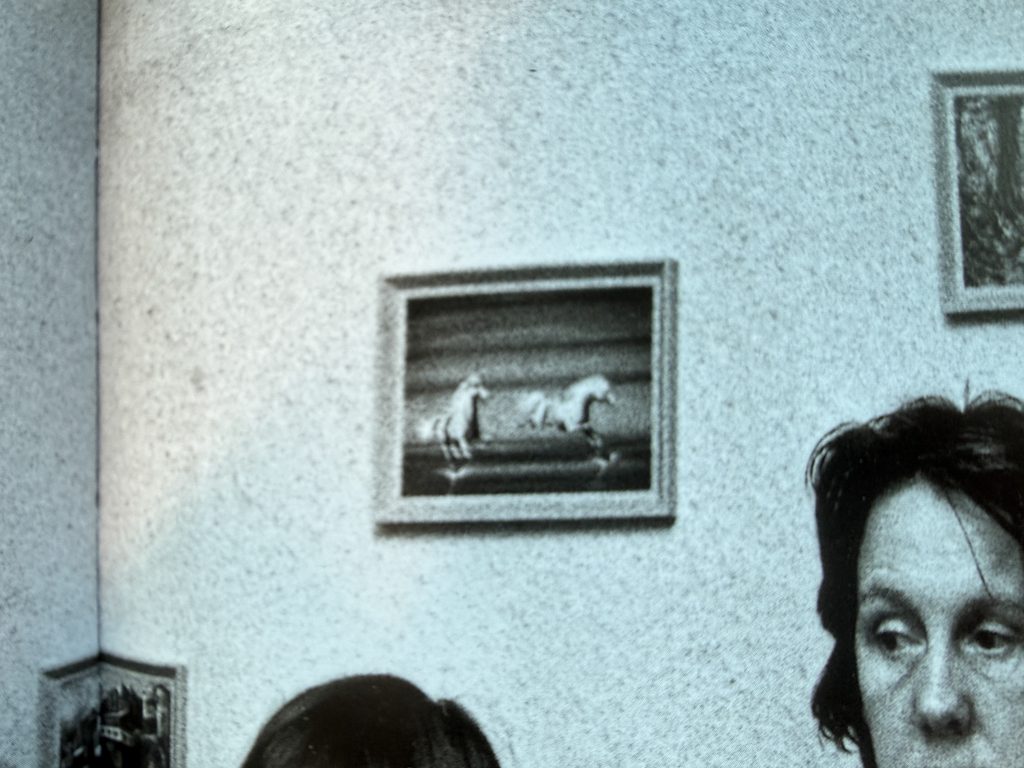
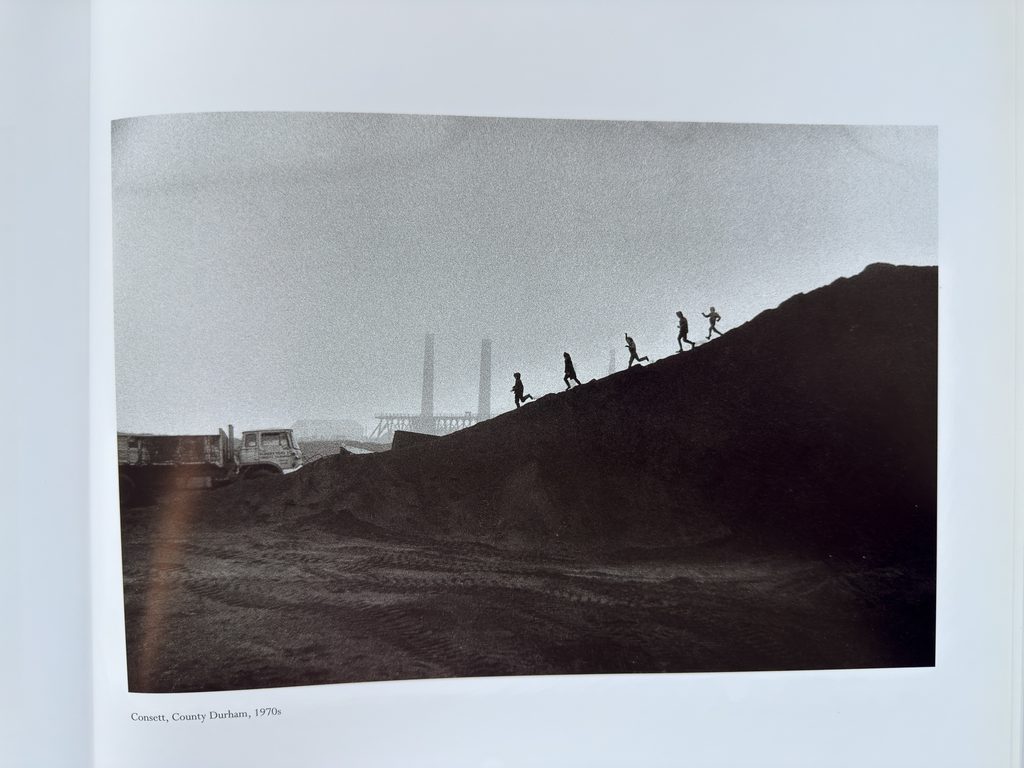
The pictures above are a couple from the book and the last one with th kids running down the pile of gravel or coal is amazing. I love a silhouette but one with the context and the environment in full display is everything. The photo of a family in their house shows a small picture on the wall of the room with two white (or Grey) horses running through an azure blue picture. I know it’s a blue colour as this same image hung on the wall in my parents house right up until their deaths.
I had an invite to go out for lunch with Nikki and Clare, and Joe, James and Podge were there too. I had a Guinness Zero and they had some food.
Lecture – From Salon To Gallery
Euripides said he is out for two weeks at the start of November, so the week 7 Gallery chat will be brought forward to Wk 5. There will be some backdrop painting next Monday at 10am, painting two backdrops. Unfortunately I’ll be at work on the Monday.
These two curating sessions are aimed at the Interim show, which will happen in the foyer gallery. This knowledge will then expand to the degree show.
The interim show will be a Salon hang, which originates from living rooms but fits into other exhibitions and art galleries.
- More organised than it might first appear.
- Frames should be in max of two or three different finishes
- Variety can be found by varying the margins size
- Unglazed/floating, and glazed can be mixed.
- Fill the space in a balanced way – it’s all down to maths and proportions
- Proportions are why things look good or don’t look good.
- Create a focal point and concentrate interest in clusters
- Two types, first tightly knit together, same distance between frames, 2″ or 5cm
- At least one corner of each piece lines up with the edge of another piece.
- Start from middle and bottom and work upwards and outwards.
- Middle of frame is always 1500mm from the floor.
- Second, more sporadic method.
- Smaller works cluster together and give larger works room to breathe
- Largest works should not be. On an edge or dead centre
Salon – Historical Overview
Art was sold originally to Churches and the Aristocracy as they were the only people who had the spare money to commission these works.
An exception to this was Holland in the 17th century, more liberal society, Europe took 300 years to catch up after the industrial revolution.
Reubens and Rembrandt took control of history through art, as the new traders wanted images of themselves to make everyone else think that they were part of the nobility
The Louvre’s Salon Carré and an illustration of the Royal Academy covered every inch of the walls, a hierarchy of subject matter. Historical paintings at the top of the hierarchy, next were portraits, then landscapes and still life at the bottom. The lowest priority of the images were the top of the wall. The values and morals of the society dictated the order of this hierarchy.
Time is the highest commodity of art, you can paint or photograph but having the time to create the works is a great privelige.
Private galleries sprung up to avoid the strict rules etc of the big Paris Salon etc.
Salon hangs still exist today but there is no more hierarchy.
This turned into a trade system then, some market forces dictate which work the artist makes.
Postmodernism in the 1970s and al of the arts councils and organisations created a different environment that is more recognisable as we see today.
Peculiar
The gallery is a peculiar space. It is a Private space and often a secluded space, where people don’t always feel comfortable, especially if new to art galleries.
It’s. a neutral space, a white cube, so no bias from the building.
They become a cultural institution as the birthplace of artistic intervention.
MoMA in New York is especially important as part of this movement to become a unified practice.
Euripides showed us examples of some exhibitions at the MoMA New York
Not everything needs to be framed or conventional, sometimes having physical objects helps.
The dissemination of the work is as important as the actual image making is, in regards to how your work is perceived. The presentation must align with the concept.
Art of The Real 1968 MoMA Black square and circle pictures.
16 Americans 1960MoMA, Dorothy Canning Miller a femal curator in the 1960’s was unusual.
Using the salon technique here links it back to history and is of great value.
Once Invisible was the first ever photography exhibition at MoMA NYC
The horses and people photos are too close together as it feels cluttered, there is not enough space to look at the work without seeing the next work along.
Exhibition was created by John Szarkowski
The exhibition fed into Szarkowski’s theory and this was then fed back into the practice.
The Family Of Man 1955 MoMA a big mix of hangs
Physicality is something you can consider
Carl Andres was mocked for 64 White Bricks at Tate.
Physical structures and objects distract from the surrounding work.
New Photography in 2023 shows a stack of prints and people can have it for nothing.
Overlapping works is not supposed to be done, the works overlapping should be the same artist.
The wraparound in the corner also joins the both walls together
Principles
Euripides then went into a summary of the principles of Salon hangs and described each of them as part of the earlier presentation.
- Visual Narrative is important.
- Consider different arrangements.
- Hang consistently.
- High or low pictures can be tilted.
- Some corners and edges should align to tie it together.
As part of the arrangement discussions we discussed trying to arrange photos in a powerpoint slide or even on a floor or wall. Moving them around to fit a narrative or sequence. Sequential does not have to be left to right as we in the west write from left to right but other cultures write opposite or even up to down and vice versa.
Next Steps
Using the information from this seminar to help guide me with the hanging of the work will also help me think about the creation of the work. Will I make pieces that need to printed in a large format to show off the scale of the subject, or would I be creating smaller scale works that invite viewers to stand a little closer to the canvas. As part of these consideration of the quality of the photo on the sensor is quite important and Euripides, Sam and Dan were asking all of my classmates what camera the images were being made on. My Q3 is a 60MP camera, my Canon R5MkII is a 40MP and my DJI Mini 4 Pro is a 48MP camera, all of which are suitable to be scaled up so I don’t think I have any concerns here.
Next step is to head out this weekend to capture some more images, as well as an evening out at a Photographic show detailing dome Polar Journeys by Ben Osborne who is part of our Shrewsbury Photoclub and has worked with National Geographic, the British Antarctic Survey, and David Attenboroughs Productions. I have bought hi book Life In The Freezer last year which contains Ben’s work and is based ont he TV Series of the same name.
Be First to Comment