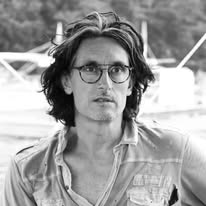
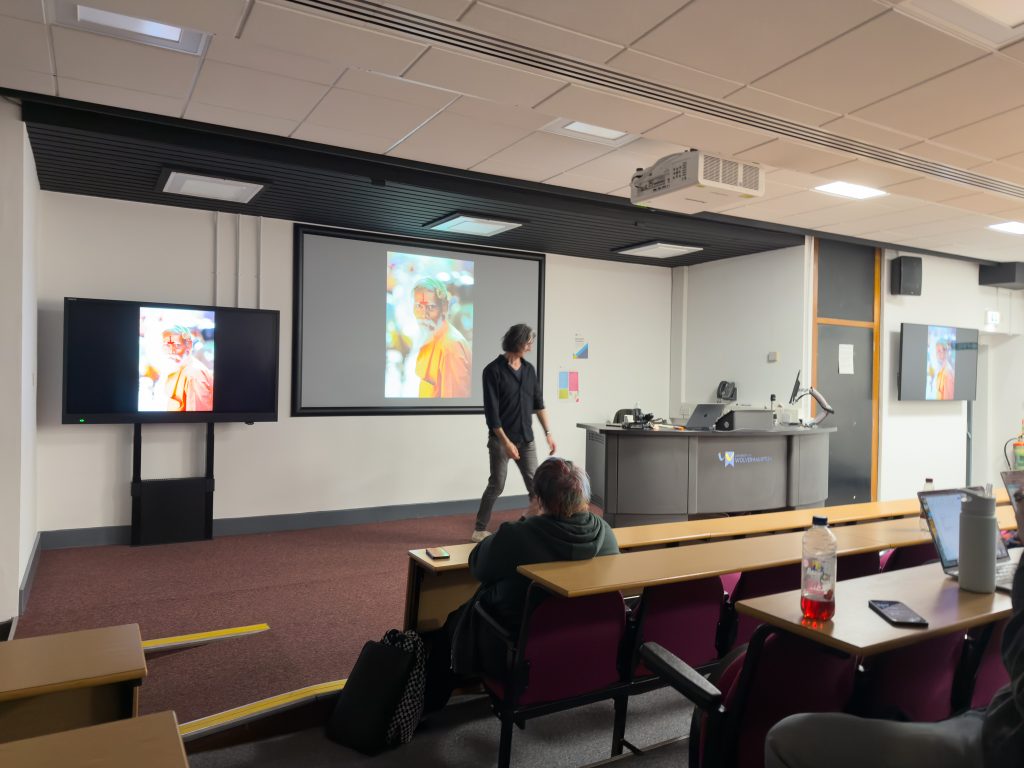
This afternoon I took a few hours off work to drive to Wolverhampton for a presentation and talk by a professional photographer, Ian Gavan. Euripides introduced him and then he went on to discuss his beginning of the career all the way through to today.
Ian studied at Wolves from Sept 89 doing a degree in Visual Communications, this was after spending time at Blackburn College doing a BTEC in General Art where he gained a good foundation of art practices.
He has photographed for Getty as a “Staffer” and shot movie premieres, film festivals and awards ceremonies, music awards and concerts, worked for de Beers diamonds, watch manufacturers, Apple TV, Leica, Rolls Royce, English National Ballet and many other clients.
He explains his work to be a result of converting caffeine and cappuccinos into finely detailed pixels”.
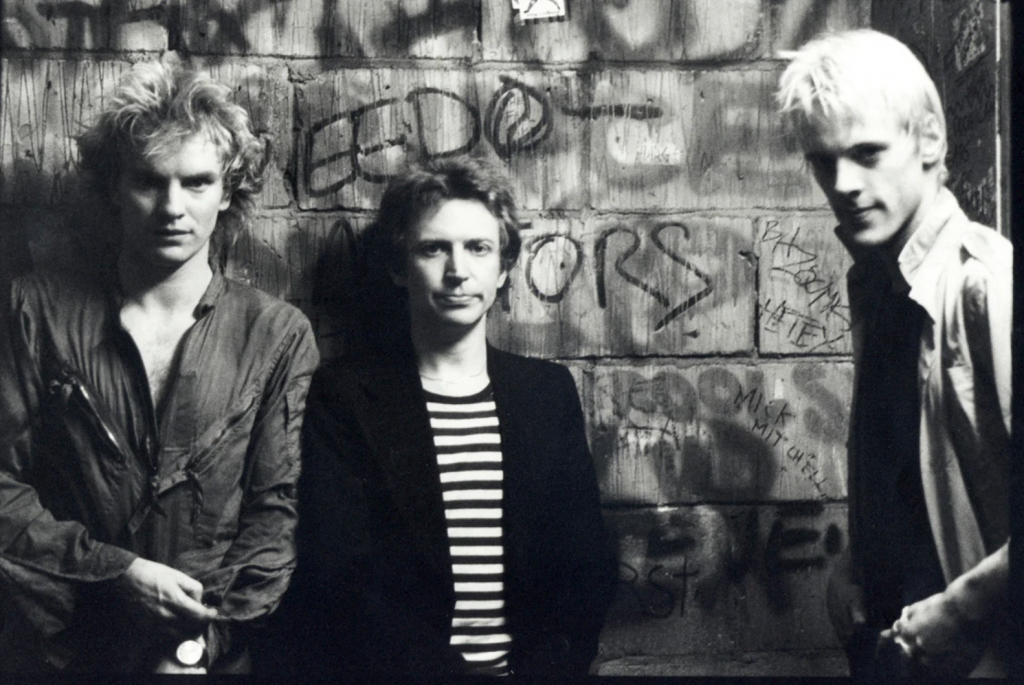
Ian became fascinated with photography after seeing some work by Jill Furmanovsky, one of her photos of The Police from 1977 in which he noticed the tonal range of the image and wondered how it could be done.
Music Photography
Ian went on to show us many of the photos from Rockarchive.com where it illustrated more of her work taking photographs of many music legends over the years. It is an impressive catalog of work and you could see just how much respect he had for her and her work. He explained that years had passed since his first exposure to her work and he was commissioned to shoot Glastonbury with a few other photographers. Of the six main togs on the pyramid stage shoot he looked down the list and saw names of people he recognised and at the foot of the list was Furmanovsky so he begged a contact or two to get him a meet with her and she was a lovely person. He showed us a great photo of Matt Bellamy of Muse who were headlining on the night.
Shot Glastonbury a few times and showed us some work from up close to the stage, then from further away using a longer lens and then from the top of an ice cream van showing the crowds and the overview of the whole site. He said it was to capture the whole story from the detail all the way out to the wider image.
He shared some photos of his time shooting at these events including some of his colleagues and even his friend Huey from PA, Brian Rasic who shot the Rolling Stones, Dave Hogan who also shot Oasis, Rolling Stones, Michael Jackson and Madonna. Ian showed us some photos of Taylor Swift that he had to get approved by Swifts mum.
He shows us photos of his work at the MTV Awards, EMA, Ivor Novellos, and explained how he uses clamps with lighting on and flash units as well as constant lighting LED panels that he can use for ad-hoc and impromptu shots. It was at this point he said he doesn’t use on camera flash as:
“On camera flash is the fastest way to mediocrity” Ian Gavan
People That Light Bounces Off
Ian explained about taking photos of famous people, celebrities and Royals and how he doesnt think of them as overly special “They’re just people that light bounces off”.
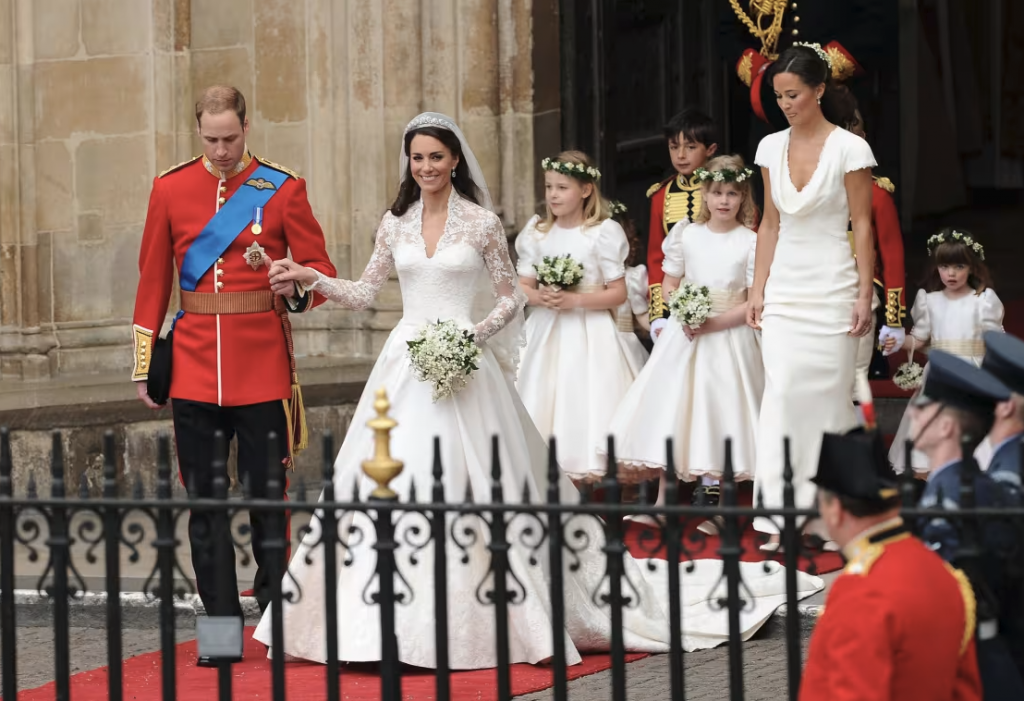
He showed us his setup for a photo shoot with a 600mm lens and how he sat on his hard case to make the shot. He then shared with us the photo that he had made from this spot of Will & Kate’s Wedding when they stepped out of Westminster Abbey. He said that his editor was stood beside him ready to snatch the memory card from his camera and then go and get it “on the wire” where it was on all the newspapers 90 mins later.
Ian is looking at cinematography and interested in film lighting after he showed us a wonderful photo of Roger Deakins, who is the famous photographer from Blade Runner movies.
He showed us some of his portraits and there was a photo portrait he’d made by shooting into a corner of a room behind him that you could see in the reflection catchlights in the subjects eys and he suggested that when you see a portrait photo on a big poster, take a look to see how it was put together. A professor also once told him to “Not Light Everything” after he shared a great portrait with us that was at least 3 stops underexposed.
Al Pacino was a big challenge of Ian’s as he was asked to go and shoot for a famous watch manufacturer Jaeger-Le Coultre and he wasn’t being as amenable as he could have been. He even had the wrong brand of watch on his wrist (Rolex) and when he had tried to persuade Pacino and got nowhere he still fired the shots off to the editors who complained that he had none of the JLC watch. It wasn’t always easy, a constant message about life ads a tog.
Ballet & Today
Ian doesn’t shoot festivals, film festivals, concerts or similar any longer as it was a tiring job, he said that you could be workign from 7am till 2am and then get up and repaeat it once more the next day. He said it was a battle to stand in your place, then take the shots and upload them to the editing team as soon as possible. He then said:
“Careful what you wish for, kids. It’s not a jolly all the time” Ian Gavan
Once he’d finished doing this sort of work for Getty they asked him what he wanted to do and he asked for access to shoot ballet dancing shows, spending many years behind the scenes or in the wings. He said that when the “curtain drops on a ballet and they fall apart like slobs, that’s where the real pictures are.”
He returned to lighting as a subject again and explained that if photographers have any spare money, they (or we) should invest in lighting not just cameras or lenses. For further illustrations of how to use lighting it’s worth watching the movie “A Streetcar Named Desire” – he also likes to play with hard lighting and less softboxes, younger subjects are more forgiving of hard lighting.
He then related a story about taking his own gear into the desert for a shoot when the rental gear failed to arrive. He stated it is better to be prepared.
Film & TV
During Covid pandemic he thought about getting into Unit Work, film and TV work and had an offer from someone who worked for Sony and he regretted remaining at Getty as a Staffer until the same person got back to him when they worked at Apple TV. In this work he got a job on a nature documentary about Dinosaurs and was working in Iceland. As part of this he was working with a Producer for some of the largest blockbusters, including No Time To Die, the Bond film. He said it was great talking to him and found that by being nice to people and treating everyone with kindness he has got further work and a better reputation.He said “Be nice to people, be gregarious and kind to everyone, from the caterer and security to the directors”.
To get some time to himself Ian goes off out shooting street photography wherever he happens to be. He finds it a good stress reduction technique and shared with us some great images that were superb.
Nuggets of Wisdom
Ian had been preparing a list on his phone of top tips for us as students. He has obviously spent some time in the various industries as a photographer and has worked with some great photographers, models, agents, production teams, movie directors, caterers, security guards, and even Taylor Swift’s mum. What I’m saying is, he has been there and done that, so it is well worth paying attention to his wise words.
- Research the subjects and find common ground so you can ingratiate yourslef with them
- Shoot it , even if you hate it.
- Shoot weddings, bride is only getting out of the car once, good skill to have, any practice is worth it.
- Quietly underpromise and then overdeliver
- Work as an assistant to photographers be there an hour early, be gregarious.
- Be nice to security and catering
- Delete all apps on phone that you waste time on. Practice all that time on your craft.
- Wear two t-shirts, you’ll never be cold and if you spill some food you can change it over.
- Increase number of good shots, look behind you.
- Situational awareness, don’t get in other peoples way (crew)
- Examine your motives, don’t just do it for the credit of being at the event or for socials.
- If youre a shrinking violet, become confident but not egotistical
- Backup everything more than once.
- Shoot personal projects, contact people and do a project with them.
- You cannot wait for the universe to throw you a bone, go and get it.
- Study the painters of classic paintings, lighting, poses, techniques.
- Most important thing in your kit bag is your attitude.
- Spent some time studying artists and Ian and wife go into museums and gallery to look at art works often.
- Worked on painting technique at blackburn college so understands some posing and human form.
- Painters learnt how to capture light, it’s a bit slower than photography
- Shoot on manual and try and guess the exposure before you shoot it, then see how you got on.
- Inspired by Ridley Scott and other cinematographers
- Winogrand, All Street Photographers, Yousuf Karsh (Churchill portrait)
- The movie Soy Cuba, I am Cuba, 1964 movie for lighting techniques.
Reflection
Obviously, Ian is a skilled photographer with a huge portfolio of work, but there is no real edge to him. He is a personable chap who gave up his time to talk to us and promote a better way of working. I’m invested in the “Be Kind to People” principles and talk to everyone with respect as he recommends.
His influences and favourite photographers are a good list and I’ve had a look at some of them on Instagram and their works are also amazing. He talks a good story about how he works with people and having a good attitude has helped with networking and getting extra work. He talks about his relationships with some people in a good nostalgic sense and has a fondness for working with people.
His work was inspirational to me and whilst I’m not big into film festivals, fashion or music shoots, I have done a bit of many things. I’ve done concerts, events such as football matches, Young Enterprise and work events, charity events, weddings, theatre performances and many other shoots but none were so pressurised that I had to get the photos out within minutes of taking the photos. That’s a pressure that I wouldn’t normally thrive in.
Be First to Comment