First a Film
This week I was into the basement early and there were many level 5 students in there raring to go.
Set up on the scanner in the corner immediately and began scanning the end of the Film 132, a roll of Colour Portrait 35mm 400 ISO film that I had exposed whilst in the US at Niagara Falls, Philadelphia, New York City and New Jersey.
After I finish with this roll, I have two further rolls to scan, both of them Kodak T-Max 400 B&W 35mm that were also shot in the Leica M6 with a mixture of Elmarit 28mm lens and Voigtlander 35mm lens being on the front.
Starting film 133 which is B&W photos of the Manhattan Skyline from the Liberty Harbour side of the Hudson River, near the Colgate Clock. I was going to upload a few of these scans in to this post but it seems that the Onedrive sync on the University Mac has not done what it should have, and as a result those scans ares still sitting on the Mac in the basement. I’ll add them here in the future.
As I was working on the Epson Scanners Sam was helping the level 5s get to grips with the Hasselblad cameras and teaching them how to use them to get the best out of their shoots. They do have a good selection of lenses and cameras. They have a couple of X1D cameras and 40,80,90 prime lenses and a couple of zoom lenses also. I might see if I can borrow some of this kit for my work instead of using my usual cameras.
Writing Right Wing
I also spent some time writing up a post for my blog about the experiences of attending left and right wing marches/protests where the left meets the right and they have a playground shouting match about their rights to raise or remove flags. It’s a tricky subject to write about and I’m sure that my biases will be readable in the writing, and possibly also in the images even though I have tried to sound fairly neutral..
Copyright ?
To quote the Canvas descrition of this session. “This session introduces the legal and ethical frameworks that underpin professional photographic practice. You’ll learn about copyright, licensing, and image rights, and how to protect and manage your work in the public domain.
This session will help unpack the complexities of Copyright by covering:
- How Copyright Protects Your Work.
- How Long Copyright Lasts
- Licensing and Selling Copyright
- Moral Rights
- Contractual Agreements
- Implied Licence
- How To Stop People from Using Your Work “
Into the Lecture Theatre at 14:00 to learn about copyright and licensing of images, this would help us in our practice with the delivering of images but ensuring we protect ourselves from losing control of the work.
The lecture was called “On Copyright”
- Even distributing copyrighted works for free is a breach of copyright.
- The law prevents people from making an adaptation of your work.
- Copyright starts as soon as you create the work.
- Written work on websites and other databases is also subject to copyright protection
- Layouts of work is also a protected piece of work, the designer owns the copyright to their layouts etc.
- The ⓒ copyright symbol doesn’t protect your work but when accompanied by the name it lets people know who made it and who to ask for permission to use it.
How long does copyright protection last?
Copyright laws are quite complex and there are different categories for different types of work.
The important ones for us as photographers are:
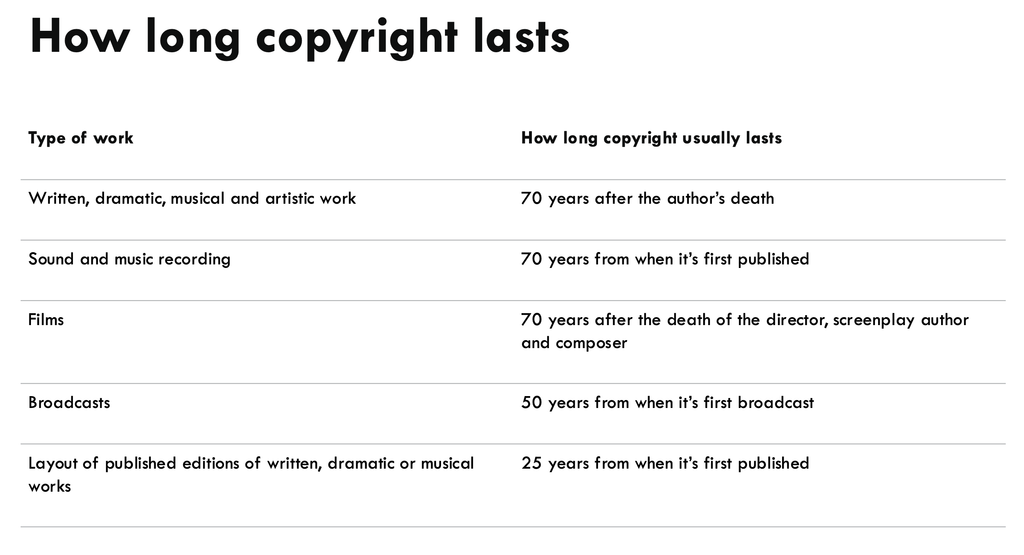
70 years for artistic works with some differentiating between dates from authors death to the date of it being first published.
25 years for layouts of published written works etc. Euripides said that it seemed unfair that designers often feel undervalued by this but that in the long run it helps with the speed of style changes across the industry.
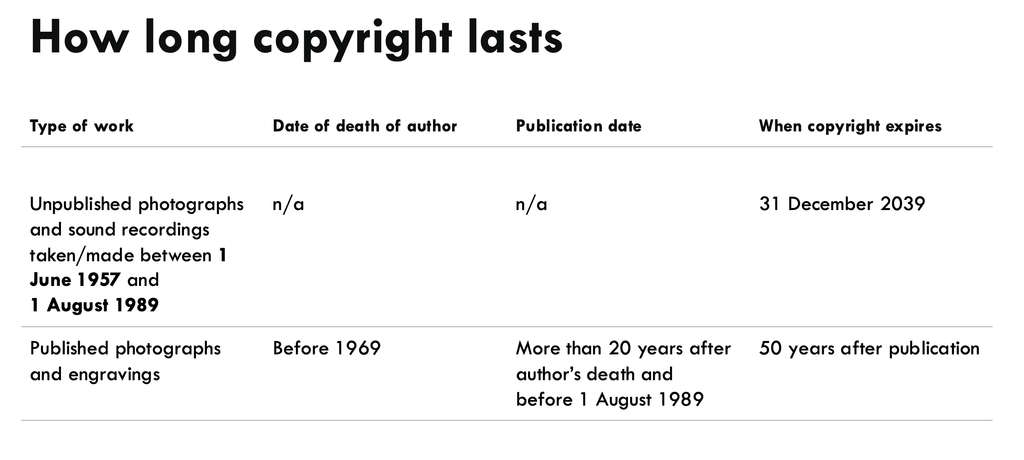
There is a pre-1989 rule (2039) rule where some work has complex rules, died before 1969 but before 89 then it’s 50 years.
Euripides went on to mention several legal cases related to copyright over the years
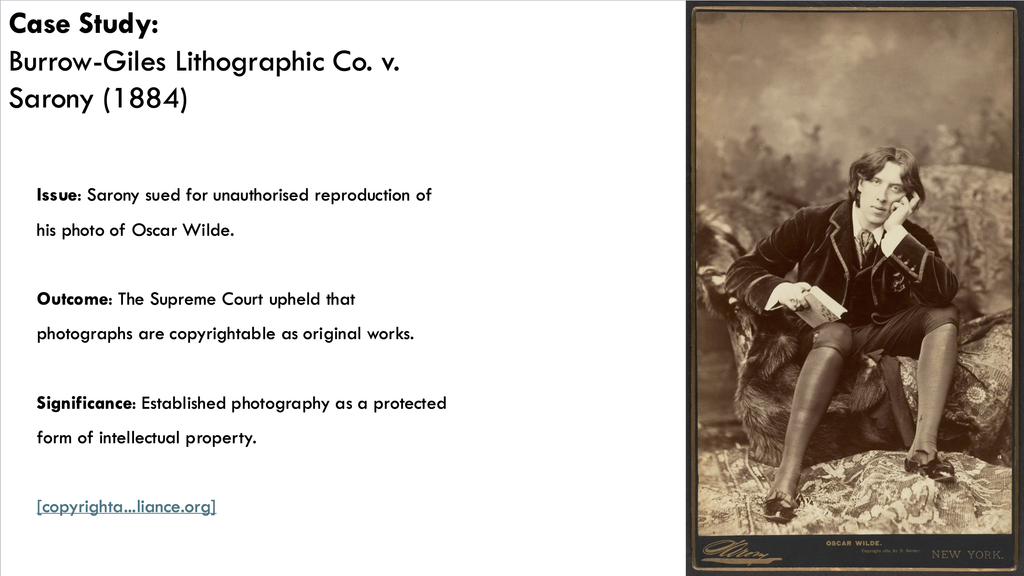
Burrow-Giles Lithographic Co. v Sarony (1884)
Where a photograph of Oscar Wilde had been reproduced by the company that the photographer was working with, and the lawyers in the case were arguing that a photograph wasn’t anything other than something captured something in real life.
It was a staged photo with background, costume, pose etc all prove a creative intent.
It was to set a precedent and established photography as a protected form of intellectual photography.
Warhol Foundation v Goldsmith (2023)
A photograph, by Goldsmith, of Prince (the musician also known as “Symbol”) was used by Andy Warhol to create a print. Warhol had used the photo to make a print, in Purple ink on a block coloured background and the photographer took it as a copyright infringement.
The district court ruled in Warhol’s favour as it was considered fair use due to being transformative.
The supreme court, however, said no it was not ok as “Aesthetic changes to work can not be considered transformed”.
Rogers vs Koons 1992
Koons created sculpture of a photo of a man and woman sitting with lots of dogs on their laps. Koons argued that it was a parody of the original photograph but the court rejected this as not enough of the image was being parodied and it was still recognisable as the original photograph. This was also a landmark case on Appropriation art an derivative works
Whitmill v Warner Bros (2011)
Whitmill sued for the use of his tattoo design on the face of a comedian in the film Hangover Part 2.
The case highlighted copyright protection for tattoos and body art as intellectual property too.
Shepard Fairey v Associated Press (2010)
Obama photograph used as the basis of a HOPE poster, ultimately settled out of court but raised questions around fair use in political contexts, as the poster was used to raise funds for the campaign it was not a “fair use”.
Cariou v. Prince (Mark Prince) (2013)
Rasta guy in photo with a guitar collaged onto him, this was judged as fair use and there was no action taken. It was judged that the change was more than enough to warrant it being fair use and adaptation. It did provoke a few snorts in the lecture theatre though that one’s work might be treated like this.
Euripides gave us the details of the Intellectual Property Office Support centre so we have a route if we ever find ourselves suffering the similar sort of trouble that Goldsmith suffered.
Licensing
Licensing helps others to use your work, and it also allows you to decide how the work is used.
Work can be registered with a licensing body. There are companies such as the UK Copyright Service which look to be almost government like but theyre not. This company charges £99 for 10 years worth of protection which involves registering the work and then keeping the chain of evidence. I don’t see that this is much more useful than the original author keeping the file safely backed up and protected but hey ho. The university also has links to Alamy, a photography agency where one can upload work and have it available for use , at a cost, by people worldwide. THey are often to be seen on press photos linked to news stories etc. Euripides says he has a code that we can ask for that sees us get royalty free access to. I have asked him for this code and will try it out, I have used shutterstock in the past and not got any traction, but it is likely down to the quality or the subjects that I have photographed rather than the agency etc..
When it comes to selling or transferring your copyright, Euripides states that this should never ever be done, unless you’re being handsomely rewarded for it. Photographs that I might take, or have taken, could be worth something in the future if I make it as a big shot photographer (you never know). If I transfer to someone else, then they have the rights to do what they want with it.
If you do transfer copyright ownership of a work then it has to be written and signed to be of any proof. Verbal agreements do not mean anything in the eyes of the law when it comes to copyright.
Has to be written and be signed.
Copyright is also inherited too, so if I make work and then die, the copyright is inherited by my estate, or my wife and kids etc.
Moral Rights
Moral rights start once the license has started and covers the image even if you think that it might not.
This protects you from people abusing the license and altering it i.e. making it black and white etc. It also prevents the work from being used for a purpose you do not agree with. Similar to how some musicians or artists have prevented US Politicians from using their music at political rallies etc.
A license is a contract between owner and user and all uses must be documented in the license agreement. Anything not listed is not permitted.
It is beneficial to impose a time limit on all license agreements, and even other criteria such as if the license holder’s audience grows etc. An increase in social network followers from 10k to 100k can automatically alter the price for the license usage, if included upfront.
Exclusivity agreements prevent photographer and others from using it and are to be avoided except in the extreme case where a large payment is agreed up front.
Implied License
Nothing in writing granting the user a license.
The copyright owner expected the user to use the copyrighted material without any written down anywhere. This could relate to a wedding photographer and a shoot that is produced for the married couple. It implies that they can use it for printing and to share with friends and family etc, but if they were starting a wedding business and using it as marketing material then this becomes something different.
This might be similar to when a logo is created, but not licensed for use everywhere.
Contractual Agreement
Important when a partner is needed to help exploit the work such as an agent.
Never ever transfer your copyright unless it’s a million pound deal.
Collecting society such as Magnum help to act as an agency to help distribute works and promote the photographer
Sell your copyright
Written signed, and clearly stated that a transfer has taken place.
This is always called an “Assignment”
You still have the moral right to the work. The right to be identified and the right to object to use in a derogatory treatment.
Protecting Copyright
The owner is responsible for defending their own copyright
Users should have a license before using it, even if they do not know who to credit. They should do some investigation to find out who the work belongs to.
Copyright is a free and automatic right. The more diligent you are in documenting your work and keeping it organised as well as storing any agreements will aid in the event of a legal dispute.
There is a Copyright Tribunal, keep a track record of all communications and screenshots of where it’s used to assist any tribunal in the event of a dispute that needs to go for external adjudication.
Representatives
After the copyright seminar we discussed the requirement of the two student reps and after a spinning wheel of fortune was used, two students were in the frame. They will become the central point for students in our course to mention any issues that they are having. They will also attend two meeting s in the year as a representative of the students and ask for more funds, technology, facilities etc.
We had a discussion about the review that we’d be presenting in Week 4. Euripides suggested that we have an audience in mind when preparing and presenting. Would it be an architect company, a weekly music magazine, or Time magazine etc.
It needs to be a five minute review and he, Sam and Dan will try to keep quiet and let the other students ask the questions.
Tutorial Time
Once wed finished in the lecture theatre we headed to the basement studios and prepared for a tutorial with Euripides, who is my tutor for the final year. He had a meeting with Clare whilst sat at the same table and I picked up some tips from his chat with her.
Think about where the work will be designed for, is it an exhibition or a Times article?
As she is looking at landscapes he asked her to consider 5×4 as this is how we see the world in real life and this makes it feel comfortable.
Use the Hasselblad if possible or the Pentax to get the maximum number of pixels on the sensor.
Also meter for the shadows in landscapes, not for the sky.
When it was my time to chat we discussed the end of this post where I discussed my ideas. These were US Road Trip, Japan Trips, Deaths of Parents, Hair Loss, Pinhole Flash, Fake AI and revisiting scenes of my youth. The last one was the best opportunity that would align with previous works. In my mind this aligns with the Shirehall work from last year, and the photo weaving from even further back.
Euripides said that he liked my use of colours and the geometry of the photos in the last year portfolio and thought that I should continue making similar works but based around the different places. He suggested that I should photograph People, Places and Things.
This last phrase reminded him of a photographer called Allesandra Sanguinetti in a Mack books publication called “Some Say Ice”. He shared with me a couple of the photos that show buildings, landscapes, portraits, closeups of items, scenes and all manner of other random photos from her time visiting a cetain location. He said that the book is in the library so I went to get it after the tutorial. THis will be discussed in another post.
His advice for my shoots was to keep the lens consistent, moving from telephoto to wide images from different lenses would break the flow and be unsettling for the viewer.
As the last point on the work that I would focus on as part of the project he suggested that I also look into the work of Sebastio Salgado, who sadly died recently. This refernce might come in handy so I’ll include this research in the post with the Sanguinetti post.
An Upright Citizen
As we were looking at my blog post he also noticed that a photo I’d published on there of the St Mary’s Of The Assumption Cathedral in San Francisco would have benefitted from better control of the verticals. He suggested I keep an eye on this, and I was a bit gutted as I’d spent a lot of time on the verticals in these photos but have uploaded an unedited version. The diffrences can be seen below.
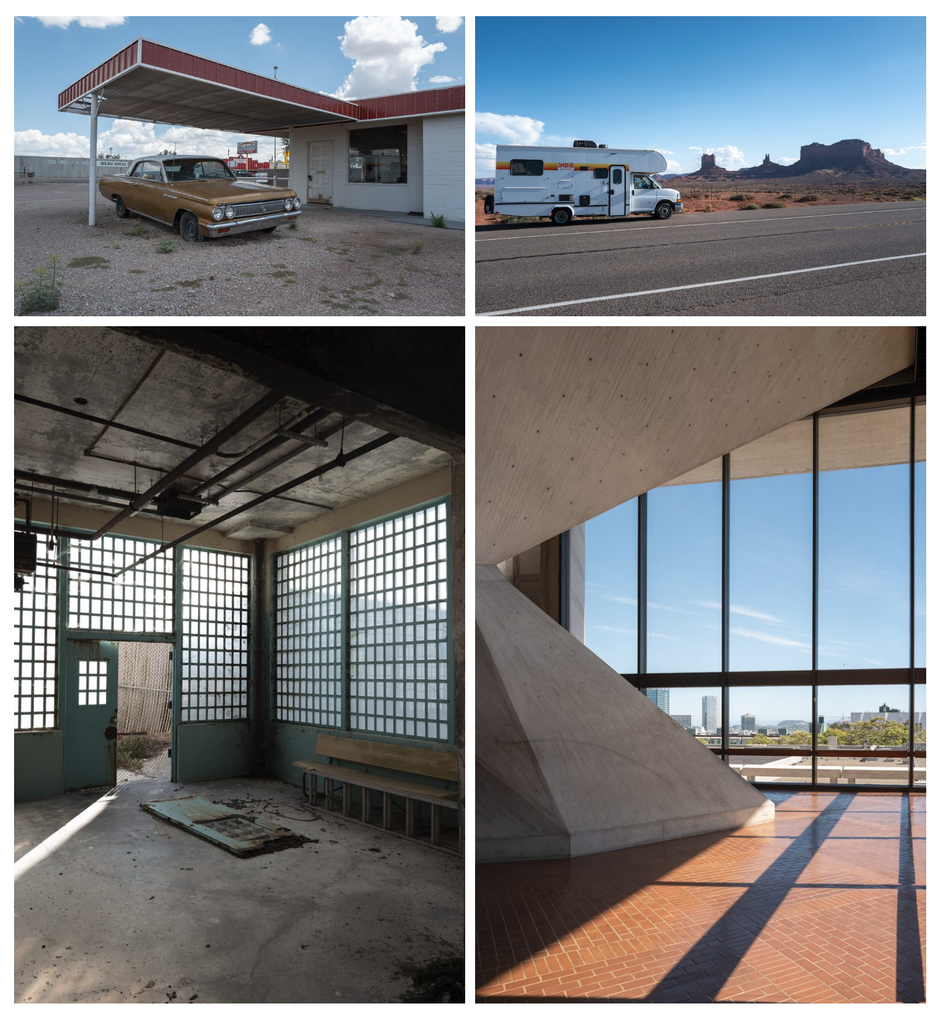
He had noticed this bloack of four images in this post and noted that the bottom right hand photo would benefit from the verts being adjusted.
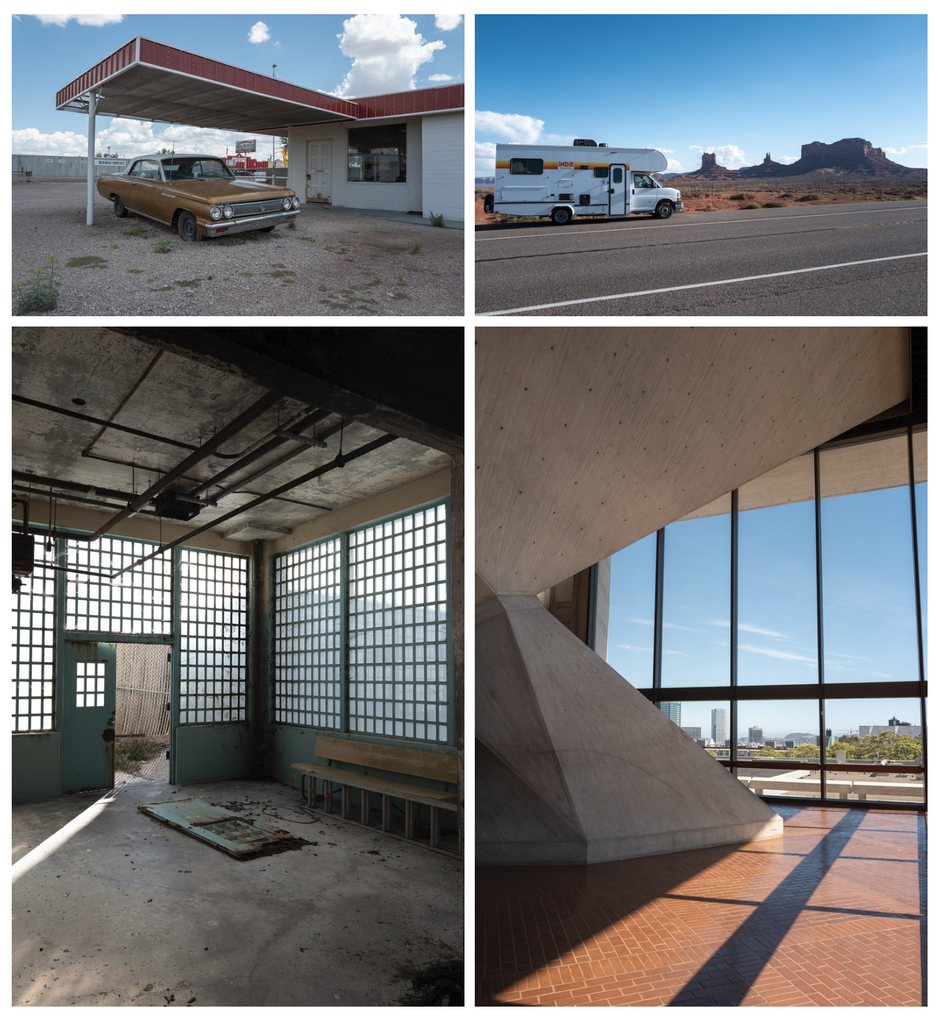
As you can see in this below photo though, I had already edited another shot to take into account this issue, but had posted the unedited version. Doh.. I will go back and update this post.
The new version of this gallery in the post looks like this with the edited shot being included instead.
Next Steps
Now I need to get out and take some photographs. I’m not available for Uni next week as I am at an AI Conference in Geneva, Switzerland. I will plan the locations for the shoots and disappear out to capture some on film som e digital, and maybe even some drone.
Reflection
The world of copyright and licensing is a confusing one at best but one that will help my and my fellow photographers to keep their work safe and in our own control. Preventing unauthorised use of other peoples works is important and one that I am quite keen on not breaking the rules of. I did fall foul of the Martin Parr and Magnum organisations when their “copyright protection” agency asked me for money to use it on my blog. I argued that it was fair use for education and ultimately it was agreed that they wouldn’t charge me any money, but it was stressful.
The information on Licensing is also great as I have done comissions for people and sent over the images with an email saying that they could use it on their website etc but nothing as concrete as a licensing agreement I might be leaving myself open. At least I havven’t sold my copyright to anyone as this sounds like the biggest mistake in the world.
I had also asked about RAW files, the unedited data that comes straight from the camera and was told to never ever send these files to customers. The photos you edit are yours and the style and output is yours, them having the RAW files can lead to them altering and producing images that don’t look like my work, confusing my audience and potential future customers. I tried to analogise it by suggesting that the RAW files of a photo are like the negatives and Euripides said that he would never sell or give his negatives to anyone, you’d be mad to do that.
It’s a valuable lesson and one that I’m glad I was available for.
Be First to Comment