Today was a case of heading into the Uni to see what will be happening this year, so first up was hitting the computer I was at last week to synchronise the OneDrive that contained all of my scanned images from the Redscale film of the Barbican. Later on in the day would be a tutorial and at the end of the day was the Private View of the Year 5 Exhibition “The Matter Of The Black Country II” which is the sequel to our Black Country based exhibition that we showed in Central last year. I’m looking forward to seeing what they get up to as I am going to be spending the time with them next year in the lead up to their Degree Show project.
I found the computer free so logged in and found that my images were still there in the cached local one drive, but it wasn’t synchronised as it required me to sign in to my Microsoft Account. As soon as I had logged in the sync began and I was able to take some time removing dust, scratches and hairs from the negative scans.
Tutorial
Gavin arrived along with the rest of the course and he came to have a tutorial with me, it proved very helpful and was a good worthwhile discussion of what I have worked on thus far, what I should be working on for the remainder of the year, other ideas of how to work on my projects and then a look through my journal to see if I am covering everything that I need to be covering.
We started off with the look at my journal so I took us back to the start of this academic year, semester one, and then he read through some of the posts and looked at some of the work that I have produced that is included in this journal. We discussed crediting images when looking at a meme that I had screenshotted, and he told me that he too had experienced issues with copyright strikes on some of his work, as I had a while ago with a Martin Parr image. I explained how the image of Charles Holden in this previous post was credited correctly and I had applied to license it.
We talked about the Shirehall project and that it was now planned to continue with the demolition, and also that I have been invited as a photographer on Friday to attend a tour of the buildings with the newly created Task & Finish Group that are going for a tour around the buildings to see if there are some aspects of the demolition and redevelopment project that have been overlooked and might be worth revisiting.
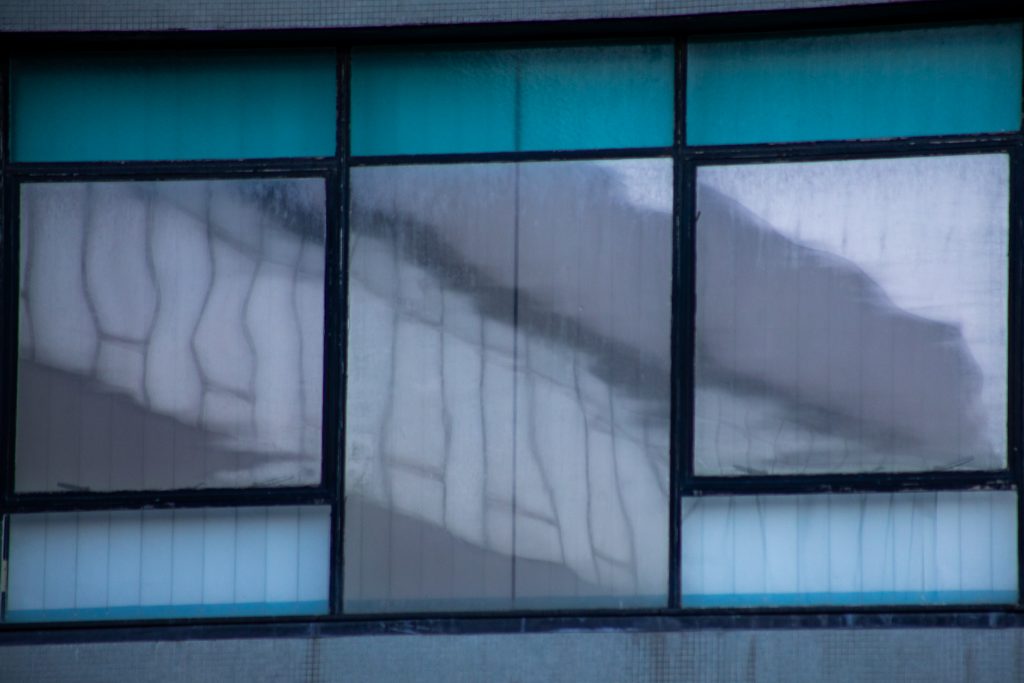
Gavin suggested that it might be a great opportunity to get involved with a larger project at the location and persuade the decision makers that this is an optimal time to get the public involved in an arts project that might leave a legacy for the building after the building has gone. He suggested I look up the project based at the Longbridge Austin Motors Car Factory led by Claire Farrell. There was also the development of Longbridge Light Festival and multiple artists all working together. It led ultimately to the regeneration, connection with the community and integration of arts and education facilities at the site. I will take another. deeper look into this project with a view of possibly learning some for the use in the Shirehall project. Gavin also offered to be a colleague and join in any meetings that might open up a possible route for the arts to get involved, saying he was also able to get other artists and organisations involved if need be.
We discussed that the outcome of today was to be a list of three actions that would keep us on task for the remainder of the year.
Outcome
Three Actions for Semester Two:
- Continue With The Shirehall Project
- Engage with the Task & Finish Group, as well as the exhibition, see where it goes.
- Tweak The Dissertation
- Spend a small amount of time to tidy up the suggestions made in the feedback.
- Continue Photographing and Journaling
- Get out with the digital and film cameras and continue to write up the work in the journal.
Dissertation Feedforward
The following is my feedforward from Gavin, my tutor, in reference to the draft of my dissertation that was handed in for a read through in December ’25.
Your dissertation is well-researched and demonstrates strong personal engagement with the topic. Also this essay perhaps the most referenced work we have had to date, a lot of background research has gone into this. Deep dive, I hope you did not drown!
To achieve an even higher mark, 80% +, focus on critical analysis and synthesis – I think your conclusion can be expanded a little too. At times, the essay leans toward description rather than argument—but this is also you writing style which I think is honest and convincing. You could expand your theoretical depth by critically engaging with psychological frameworks rather than just summarising them. But this would result in lots of removing of content, which would also be a great loss to the overall argument. Criticism is hard if the things you read are so well argued, but perhaps focusing on the limitations of the research in an evaluation of sorts at the very end of each section and the very end of the whole essay allows for this critical voice to shine though.
Also celebrate your framework a bit more in the conclusion!
My advice is make a few small changes and focus on your practical work which is coming along nicely. Well done Bob! – Gavin Rogers
Before Christmas I was chatting with my wife about what I expected to come back in the feedback (or feedforward) and I had remarked that I thought it would be something along the lines of having too much information pulled from different sources and not enough critical comparison or argument as to whether it is a good or bad thing, whether it works or not etc.
The response from Gavin pulls out that I have spent much time researching and documenting, which I’m pleased about and it also mentions that I could focus further on critical analysis and synthesis whilst expanding my Conclusion section. He also mentions that expansion of critical review of the Frameworks might mean removing word count on the other stuff too which could be a loss.
I will spend a few hours, not as many as I did writing the thing originally, but a couple just going through and reducing the descriptive parts and seeing if I can introduce some critical comparison between the two or more schools of thought.
Gavin mentioned in the text above the feedback that there were some comments over the top of the dissertation in the Canvas upload and after talking to him I was able to access it. It is basically a small amount of red pen comments on how to rejig some of the contents to work in a better order with some great advice that will help me with the possible increase in mark.
Overall though, I am pleased with the response to the dissertation, it doesn’t say I haven’t done enough research or haven’t put enough thought into it, or anything even worse. It is a positive result and one that allows me to make a few small changes to get it into a better position to get over the 80% mark.
Redscale Discussion
As I was sitting there editing my Redscale photos of the Barbican, Euripides came over to have a chat about the process and the use of this type of film. He showed me a couple of his photos from his instagram grid that were made with Redscale film that he had created himself from rolls of film, that he keeps secretive to ensure his supply isn’t diminished quickly. He takes a roll of normal film and then reverse it in the dark room by unrolling it all, reversing the film layer on the backing and then rewinding it into the roll. This is then used to shoot his scenes and the results he shared with me are not the basic yellow that I seem to get on my images but contain some awesome colours such as magentas and blues as well as other colours.
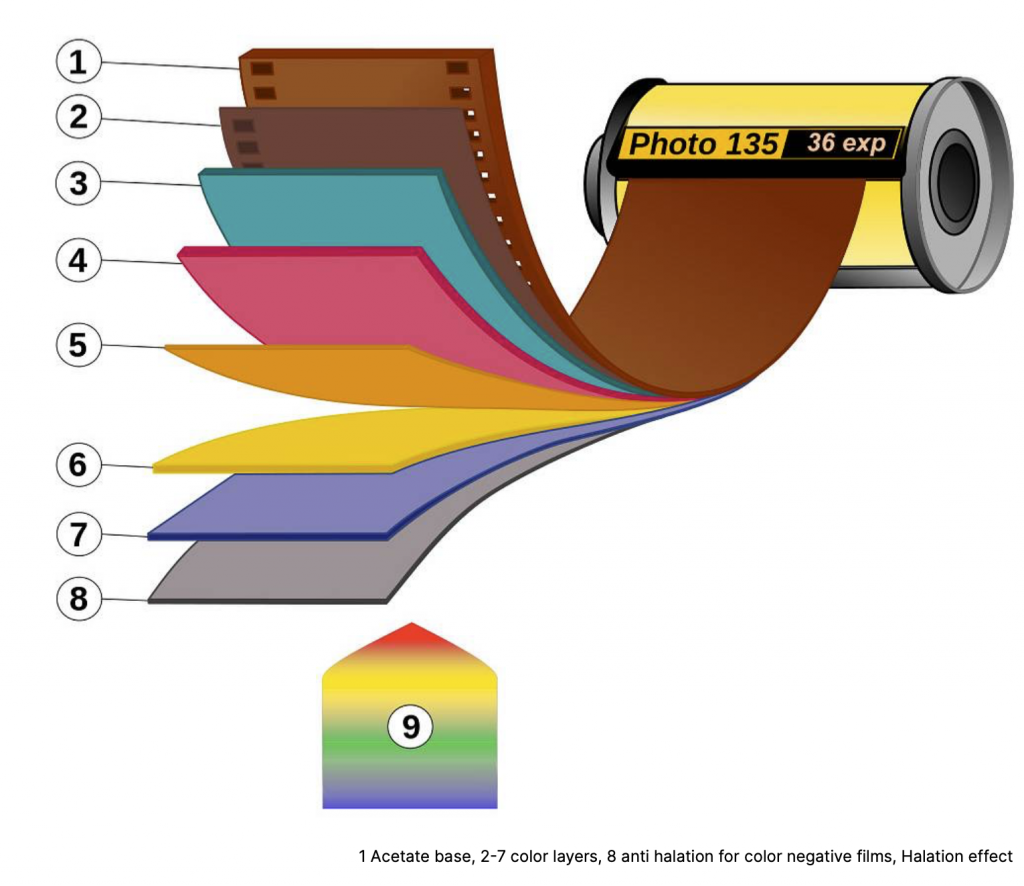
He explained the theory of how these extra colours come to appear in the images when I don’t get anything like that in my images. The reason, he explained, was that the Harman Red or Lomography Red film is not a top quality film that has been reversed, but a basic film. He said that the better quality films have more layers of colour reactive chemicals on the plastic backing and by carefully exposing the images you can control how much light reaches the layers further down, leaving those untouched and resulting in different colours appearing in the final prints.
This illustration, from Lomography.com displays a generic film with the layers shown separated. In this diagram, imagine that a normal film is used and the ins shutter opens and the light goes into layer 8 then 7 and all the way through to 2, the layer number 1 is the plastic backing that the chemicals are left on. In Redscale, these layers are reversed and the light enters the camera and passes through Layer 1 first but each layer in is affected by the filtering of the layers before it. This is the same process as a normal exposure but the film has been designed originally for the most optimal passthrough of light with the filtered light making it through to the next colour.
Euripides talked about how next week, he would help me reverse a couple of rolls of expired Fuji film in the darkroom for me to use and try it out using a bracketing method to trial the exposures and see what comes out the best. He explained also that he really enjoys shooting Redscale film but is not a fan of the fiddly nature of reversing a medium format roll of film.
Next week will see some excellent opportunities to try this stuff out and have a play with different options. Looking at the module plan for next week too I can see the following requirements.
- Select 10–15 images for review and refinement.
- Experiment with editing, sequencing, and layout.
- Reflect in your journal on how these changes affect your project’s meaning and coherence.
So I think I’ll collect together 10 images and have a look at the sequencing of them alongside the others. Just have to see how it goes.
Be First to Comment